
Human Conversation with Leah JM Dean

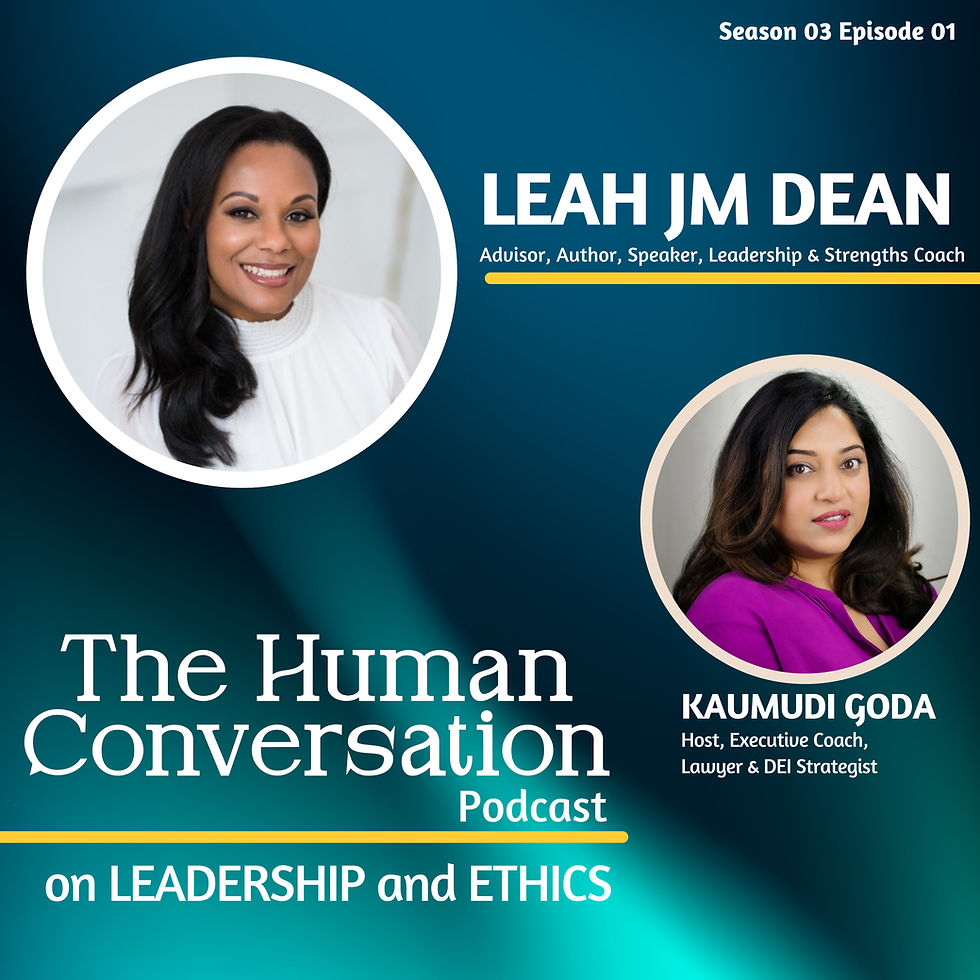
Get To Know Our Guest:
Leah JM Dean
She is the Founder and Chief Executive Officer of Conduit International Ltd a professional and personal development solutions company dedicated to helping organizations, leaders and women work smarter, live well, and foster meaningful connections.
With over two decades of experience, Leah has shaped leading HR strategies and served as a trusted coach and advisor to thousands of leaders, employees, and women across the globe. Leah has also led teams and has experience in Strategy Development, Mergers & Acquisitions, Boards & Governance, Professional Speaking, Facilitation, Executive Search, Corporate Communications, Facilities, Administration, and Corporate Social Responsibility.
As the CEO of Conduit International LTD, Leah and her team have worked across diverse industries, including insurance, reinsurance, education, non-profit, faith-based, financial services, food and beverage, and business consulting.
Leah holds an MBA from St. John’s University and is a certified strengths coach. She is also the author of two books Be Different & Assemble the Tribe, which was named Bermuda’s most popular book of the year in 2021.
A self-proclaimed recovering workaholic, Leah is passionate about helping women and organizations to find strategies to optimize their work, invest in their wellbeing and make a lasting impact on the lives of those they touch.
When she is not working, Leah enjoys reading, writing, walking in nature, and spending quality time with family and friends. She lives in Bermuda with her husband Terrance and two children.
HIGHLIGHTS & TAKEAWAYS:
KG: You've done so many different things. You've had an impactful career in corporate leadership, speaking, training, coaching, writing, mentoring all over the world. Is there a red thread that ties all of it together for you? I was curious about the driving force behind all that you do.
LEAH: I had to say that there was a thread, I think the thread that weaves, that has woven its way through everything for me, it really comes back to my mind.
LEAH: I guess if I had to sum it all up, my why in this season and my why for my work and my business is about helping organizations and leaders and women to work smart, to live well and connect with people.
LEAH: I'm a strengths coach, so I believe we all have strengths and talents that we can develop into strengths and we should look to unleash that unlock it, the live well piece it's I think we're whole people and so there's the part of us that shows up at work. There's a bus that are leaders there's a gift that we have to give to the organization. But so many leaders do that at the sacrifice of themselves and so how can we live well? And then the connect people has just been my work for the last seven years or so, how do we build community? We need community to live our healthiest, happiest lives. And so all the work that I'm doing every day kind of plays.
KG: What a beautiful thought. It makes space for varying focus areas and varying needs in different stages of life, but also enables people to identify core values that drive a person forward.
LEAH: My experience is that your purpose, or purpose by definition, is the reason you exist. You are literally your purpose when you walk into the room and how that purpose is delivered or resonates or shows up in different seasons will change.
LEAH: When you leave yourself open to the possibility of change, like the world just opens up in a much bigger way than if we put ourselves in these boxes.
KG: What is your idea of ethics and leadership? What do those stumps mean to you?
LEAH: Ethics are the principles of conduct that govern an individual or group. They're the principles that drive us as individuals or groups of people. Integrity is really about adherence to a code of values.
LEAH: Values is like the anchor. It's the thing that, they're the things that keep you grounded in what matters. And then ethics is like the chain connected to the anchor. They connect to your anchor, your daily decisions, they give structure and tension. And then integrity is like the steadiness of the vessel. It shows if your anchor and your chain are keeping you from drifting when the current shifts.
LEAH: Values are what you believe is important. Ethics create the rule to honor those beliefs. And then integrity is how you live them out when they're watching.
KG: Do you have a personal story of a time when you had to navigate a different difficult ethical dilemma? But how would the outcome of that incident might have been?
LEAH: Values, there's deep fundamental beliefs. They're both actual and aspirational. I've learned is that as we grow and as we develop, if we accept that we each have the capacity for change, then it's also possible that our beliefs are going to change, which means the chain and the tension is also going to change over time as well.
LEAH: When we're navigating these issues, I think it's really important that we leave some room to grow, that we leave some room for grace. And then we also have to remember that a lot of the deep work that we're going to do is actually in the gray.
KG: A lot of dilemmas and leadership is around the fact that there is no one true clear answer. It's so contextual and you're saying what's important is to maintain a sense of agility and fluidity instead of brittleness and rigidity around looking at things with the binary lens.
LEAH: Shortly into my tenure I was asked to do something from a values and ethics perspective. I just thought it was unethical. And so my answer has to be that under no circumstance can I do that thing that you're asking me to do. And so at the end of the day, this is the decision that you have to make.
LEAH: Sometimes when we think that there are these values and ethics that we stand on, we think that we should know the right answers all of the time. Sometimes what we really need to do is take a step back and as you said, give ourselves space to consider all of the options.
LEAH: These issues that we navigate are never one dimensional. They're often complicated. These issues are going to come up again and again and again. And in some ways it feels like we even more increasing frequency right now and I think if we give ourselves the space to say what's the right answer for this moment I think that we will find ourselves in a better place.
KG: These days, taking a stance seems like a dangerous thing to do. That you'll alienate some people, that you'll figure out this is what you care about and being seen and being authentic can sometimes feel dangerous because of public scrutiny, because leaders can be cancelled and they are quite often.
KG: In all of this, what gave you the strength and the clarity to say this is important and I'm okay to take a stance? How can someone evaluate for themselves and make a timely decision on whether or not to take a stance? Can you share a little bit about how you thought it through?
LEAH: I think there's two deciding factors. One is value. So for me, one of my values is trust. And the definition that I use for trust for me, for my trust value, is trust is where your intent and your behavior line up.
LEAH: I want to lean into the work smart part of my mission. The other thing that I think helps me is some of my strengths can be very, some of them have a force to them. There's part of me that says, how can I turn the strength on myself to make sure I do the right thing? And so that's part of how I kind of processed how I was going to show up. Like, yes, it's uncomfortable. Yes, you don't really like it, but you have the strengths of responsibility and command and activator.
LEAH: If the goal is for the organization to achieve results, if the goal is to bring people together, then we owe it to ourselves and the organizations and the situations to have these conversations. And for me, my value said I had to give back.
KG: Do you have any observations on ethical dilemmas most relevant today? And what would your advice be to professionals, leaders, organizations?
LEAH: How do we deal with the divisiveness that we see as people pick a spot and then dig in and entrench into those corners? And so the dilemma that a leader often has is do I then couple that with my own beliefs and values and then double down in that space? Or is there something else that I should be doing?
LEAH: My reflections come from my last piece of work, which is a book that I wrote. It's more of a faith-based book. It's called Be Different.
LEAH: I often take a piece of work and I say, how could I apply that in a leadership context? And so there is a model that is embedded in this whole idea of being different in that book. And when I apply that from a leadership context, it pushes me to ask leaders to first ask the question, how can I be different?
LEAH: There's five pillars. 1) Listen Different 2) Trust Different 3) Think Different 4) Talk Different 5) Live Different
LEAH: The simple definition that I use for that is leadership is about unlocking the greatness in others to achieve results, right? And so if I want to unlock the greatness in my team that has very different views, then what is it that I need to do in order to get to that place that allows us to move forward together?And I would contend that the answer that every leader has to challenge themselves with is how can I be different in the gray.
KG: How does that work in a rapidly evolving world with so much uncertainty, so much accelerated change, and with a lot of uncertainty also in how do we create an AI-empowered, fair world and not an AI-driven chaos where we can't quite control these very systems that we half-bakedly built. Can you help me understand how this framework that you're recommending will fit the leaders operating in this level of uncertainty too?
LEAH: I watched this TED Talk on emotion and stress. And the particular speaker, she said, often we are afraid of certain things, but actually we need to use that stress and discomfort as a beacon, almost guiding us towards the thing that we need to address.
LEAH: You have to talk a little bit differently. You have to talk with more hope. Listen, here's what I, I don't know what's going to happen 10 years down the road, but here's what I know today. And here's how you're adding value. And here's how I can continue to support and develop you. And that may be the only answer that you have, but use the pillar and the anxiety to kind of guide you into your next best step.
KG: What advice do you have for leaders on how to build cultures of integrity in their organizations, in their teams today.
LEAH: There's a quote that I use as one of the principles for the program, which says, the feeling is normal. The feeling of fear, the feeling of anxiety, the feeling of frustration, the feeling of anger, the feeling of imposter syndrome, that just makes you human. But it's the decisions that you make after the feelings that matter.
LEAH: All of those things that we feel, all of those things that your employees feel, they are absolutely normal. They are part of our human experiences, but it's decisions that we make after the feelings that matter. So we can give ourselves space. We can go get advice. We can listen a little bit differently. We can think a little bit differently. We can ask ourselves, how can I be different? and that's okay.
KG: That quotation pairs beautifully with the leadership model and framework you recommended before. Feeling is normal. Fill in the blank. Whatever feeling you're feeling right now, that's normal. What's the next decision you make? It's that decision that matters. Between the feeling, the feeling and the decision lies the framework. Listen, trust, think, talk and live different. Apply that and then hopefully a decision will emerge for you as you apply the framework.
KG: Where is your research taking you these days? What are you excited about with regard to all of your work?
LEAH: There's that live well right in the middle. And the reason why I'm focused on that in the moment is because when I talk to leaders, they share with me I absolutely understand these are the things I have to do to manage well. These are the values that anchor me. These are the things that I need to do to be able to operate more strategically and achieve results. But how can I do all of those things while still not sacrificing my own well-being? I'm a whole person. You know, I need time to invest in my well-being.
LEAH: Based on my strengths, I am wired to execute. I am wired to work. And so some of this journey for me is in my quest to help others. I will also help myself and that's where my work is taking me at the moment. And so I'm just looking forward to what will reveal itself as I study what does it mean to really live well in our lives and our leadership while still making an impact.
REFERENCES & LINKS:
LEAH’s Social Media Platforms
LEAH’s Books/Newsletter/Resources
The Human Conversation Podcast Channels


Comments